Cloud Dynamics Secret Recipe

A blueprint for Success
Most enterprises already have AI activity—the challenge is turning fragmented experiments into measurable, secure, enterprise-scale value. Our approach uniquely brings together two disciplines: Business and Mission Transformation, which identifies where AI can materially improve processes and outcomes, and Enterprise Agentic AI Architecture, which determines how those opportunities can be delivered securely and at scale. We establish direct traceability from executive priorities → business processes → AI opportunities → enterprise technology → measurable outcomes, ensuring technology investment remains anchored to business and mission value. During a focused 12–16 week engagement, we assess the current environment, identify process and technology gaps, redesign priority workflows, define the target architecture, and build a prioritized implementation roadmap. Importantly, this is not a rip-and-replace strategy; we identify how existing applications, data platforms, infrastructure, security controls, and technology investments can be reused and optimized. Leadership receives an actionable portfolio of AI opportunities, architecture gap assessment, transformation heatmap, target-state architecture, governance model, investment priorities, and a 12–24 month execution roadmap. Because the framework is modular and industry-agnostic, the same methodology can address operations, customer experience, cybersecurity, finance, or complex government and mission environments. The outcome is a disciplined path from AI experimentation → AI-enabled processes → governed enterprise AI → measurable business and mission results. We help leadership answer the most important AI investment question: where should we invest first to create meaningful value, and what must be in place to execute it successfully?
DYNAMIC Technology Framework
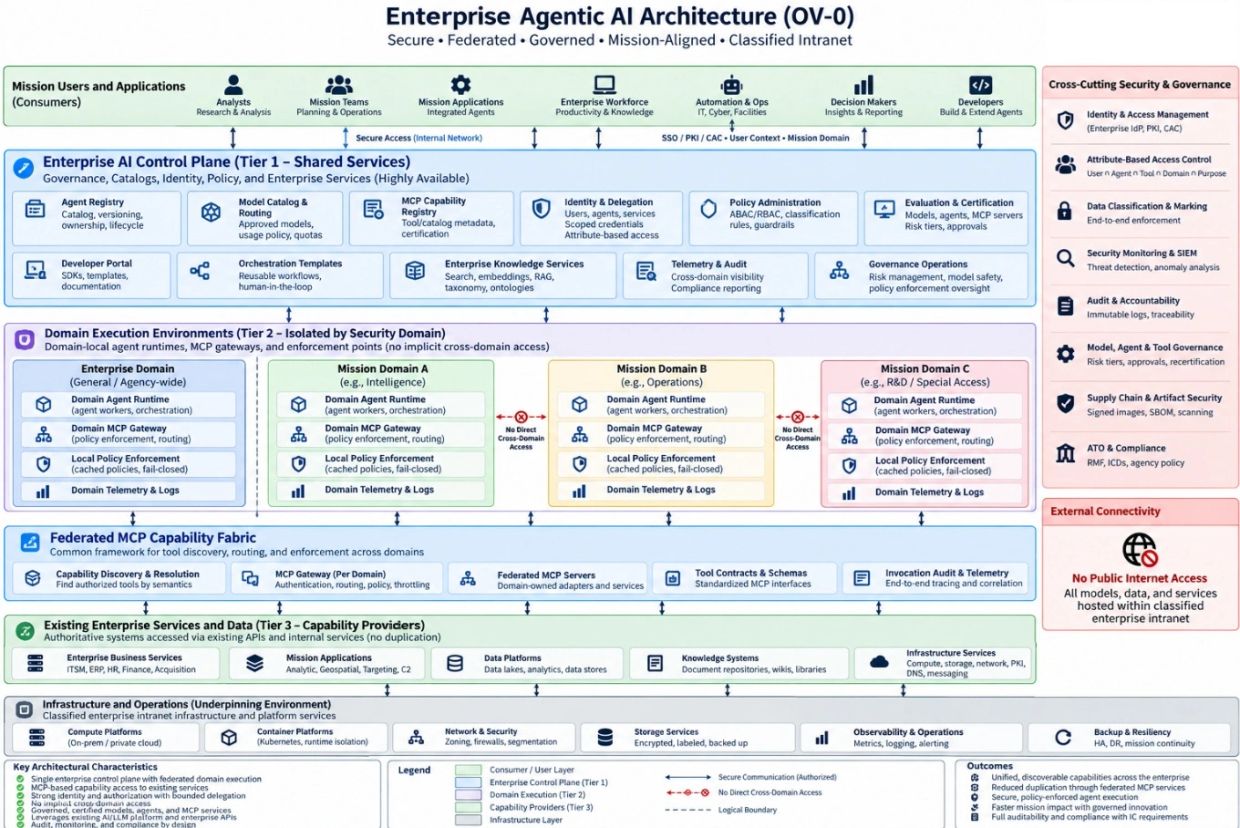
The Architecture that is focused to scale and adjust to mission and business need
This architecture provides the enterprise foundation for scaling AI agents securely without replacing the systems, data, and infrastructure you already own. At the center is a shared AI Control Plane that gives leadership enterprise-wide visibility and governance over agents, models, identities, policies, capabilities, certification, and audit. Mission and business units retain the ability to innovate locally through isolated execution domains, while common governance ensures that every agent operates within clearly defined security and authorization boundaries. The Federated MCP Capability Fabric creates a reusable integration layer, allowing approved agents to securely discover and access enterprise capabilities without rebuilding point-to-point integrations for every AI initiative. Existing mission applications, ERP platforms, data environments, knowledge repositories, and infrastructure remain systems of record—protecting prior investments while making them accessible to the AI ecosystem. Security is engineered throughout the architecture with identity, least-privilege access, data classification, continuous monitoring, auditability, supply-chain controls, and compliance embedded by design. This federated model enables organizations to govern centrally while executing locally, balancing enterprise control with the speed required by individual mission and business teams. Most importantly, it transforms disconnected AI projects into a secure, reusable and scalable enterprise capability, providing a practical path from experimentation to operational AI at mission scale. Our role is to assess your current environment against this architecture, identify the gaps, and create a prioritized roadmap that gets you there without a costly rip-and-replace transformation.
Mission / Business Process Transformation
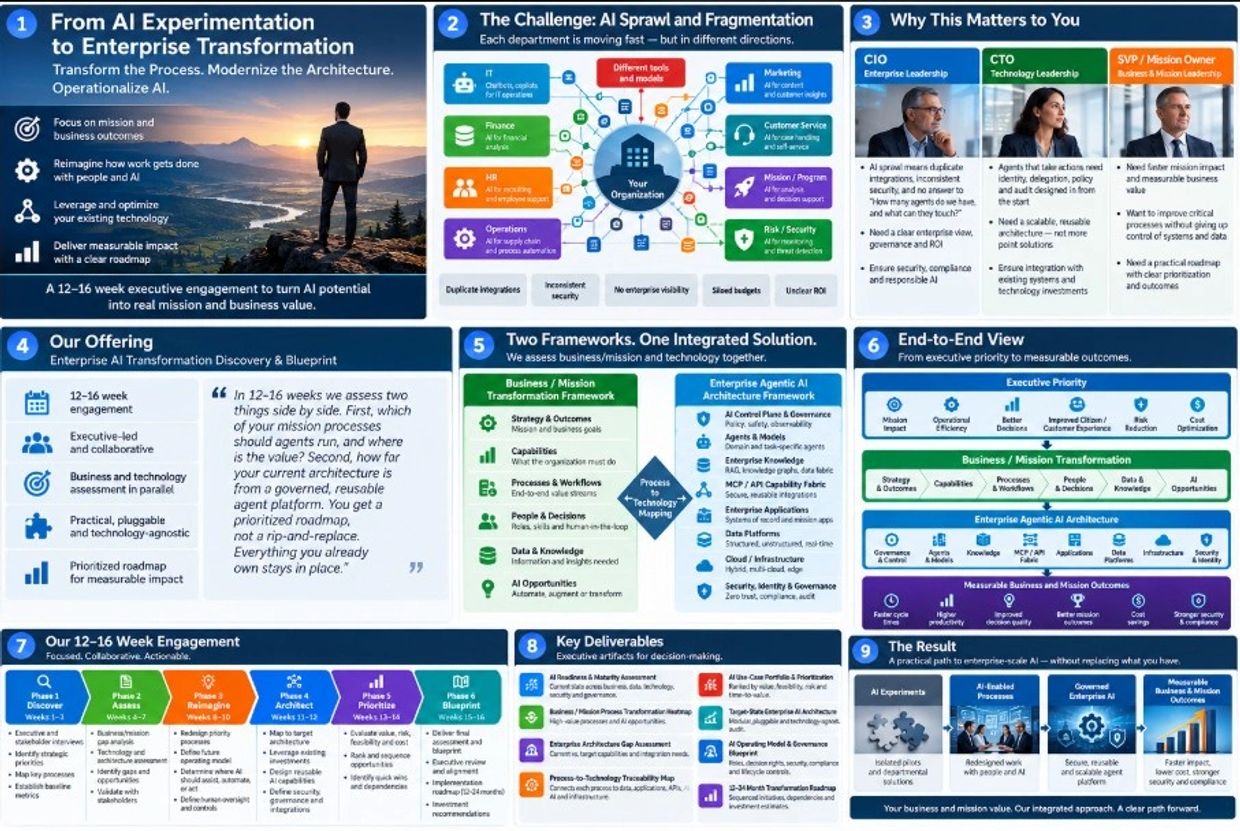
Let's unpack and simplify
Most organizations are no longer struggling to start AI—they are struggling to scale it without creating fragmentation, risk, and duplicated investment. Our Enterprise AI Transformation approach connects two disciplines that are too often addressed separately: transforming the business or mission process and modernizing the enterprise architecture required to enable it. We begin with your strategic priorities and identify the processes, decisions, workflows, and data where AI can deliver the greatest measurable impact. In parallel, we assess whether your current architecture, applications, data platforms, integrations, security, and governance can support those opportunities securely and at enterprise scale. We then connect these two perspectives through process-to-technology mapping, ensuring every AI investment traces directly to a business or mission outcome. Rather than recommending wholesale technology replacement, we emphasize reuse, interoperability, and optimization of the investments you already own. Over a focused 12–16 week engagement, we turn those findings into a prioritized portfolio, target-state architecture, governance model, and actionable transformation roadmap. The result is a practical progression from isolated AI experiments → AI-enabled processes → governed enterprise AI → measurable business and mission outcomes. Our objective is simple: help you invest in the right AI, apply it to the right processes, build on the right architecture, and produce outcomes leadership can measure.
One Transformation Model
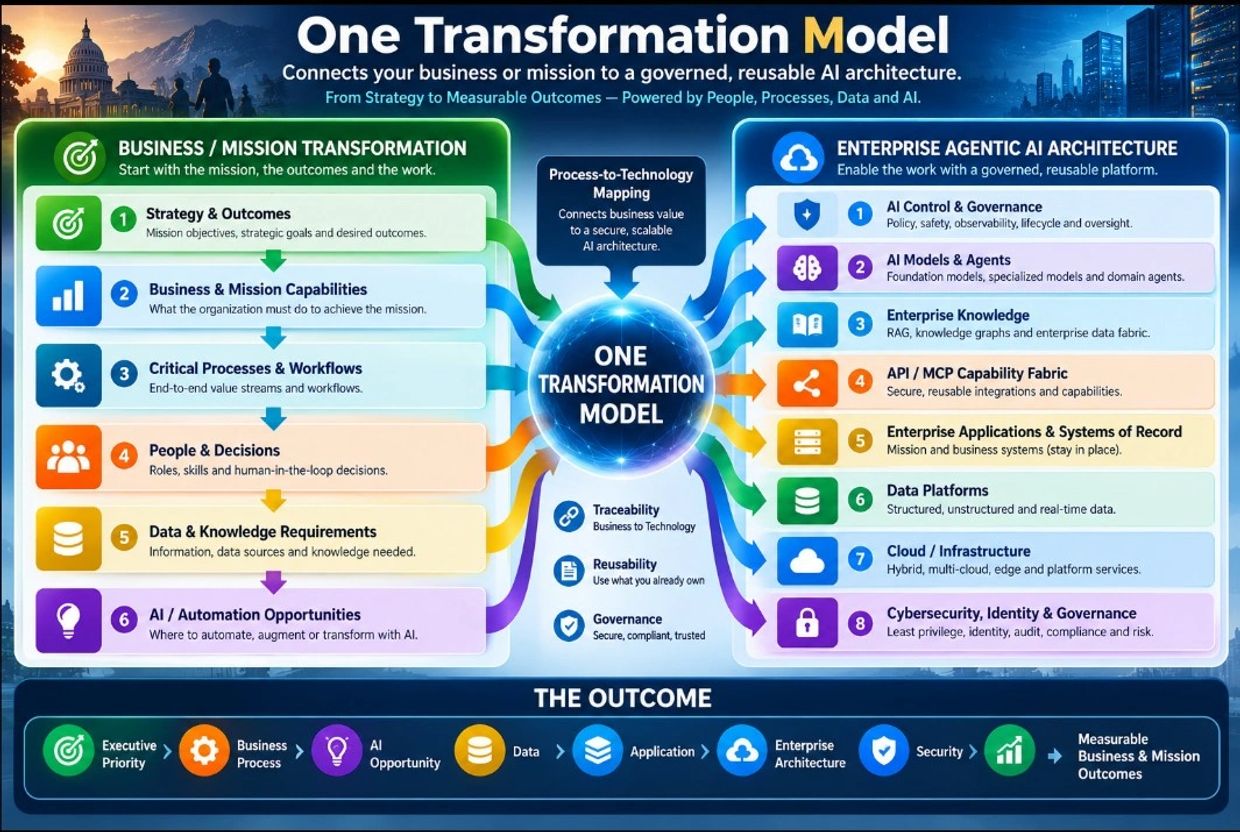
One Transformation Model
This One Transformation Model creates a direct, disciplined connection between executive priorities and the technology required to deliver measurable business or mission outcomes. We begin with the mission—aligning strategy, capabilities, critical workflows, people, decisions, data, and knowledge to identify where AI can create the greatest value. Rather than introducing AI as another technology layer, we map each opportunity directly to the enterprise capabilities required to operationalize it. On the technology side, our model connects AI governance, agents and models, enterprise knowledge, APIs and MCP, existing applications, data platforms, cloud infrastructure, cybersecurity, and identity into a reusable architecture. The result is business-to-architecture traceability: every technology investment can be tied to a defined process, mission requirement, and measurable outcome. Just as importantly, the approach is designed to reuse and optimize the technology you already own, minimizing unnecessary replacement and vendor lock-in. Governance, security, identity, and human oversight are incorporated into the architecture from the outset rather than added after deployment. Ultimately, we provide leadership with a practical path from Executive Priority → Business Process → AI Opportunity → Enterprise Architecture → Measurable Business and Mission Outcomes.
Key Questions to Ask
Operationalize with the trained talents
Mission / Business + AI Tech Convergence
CONVERGENCE
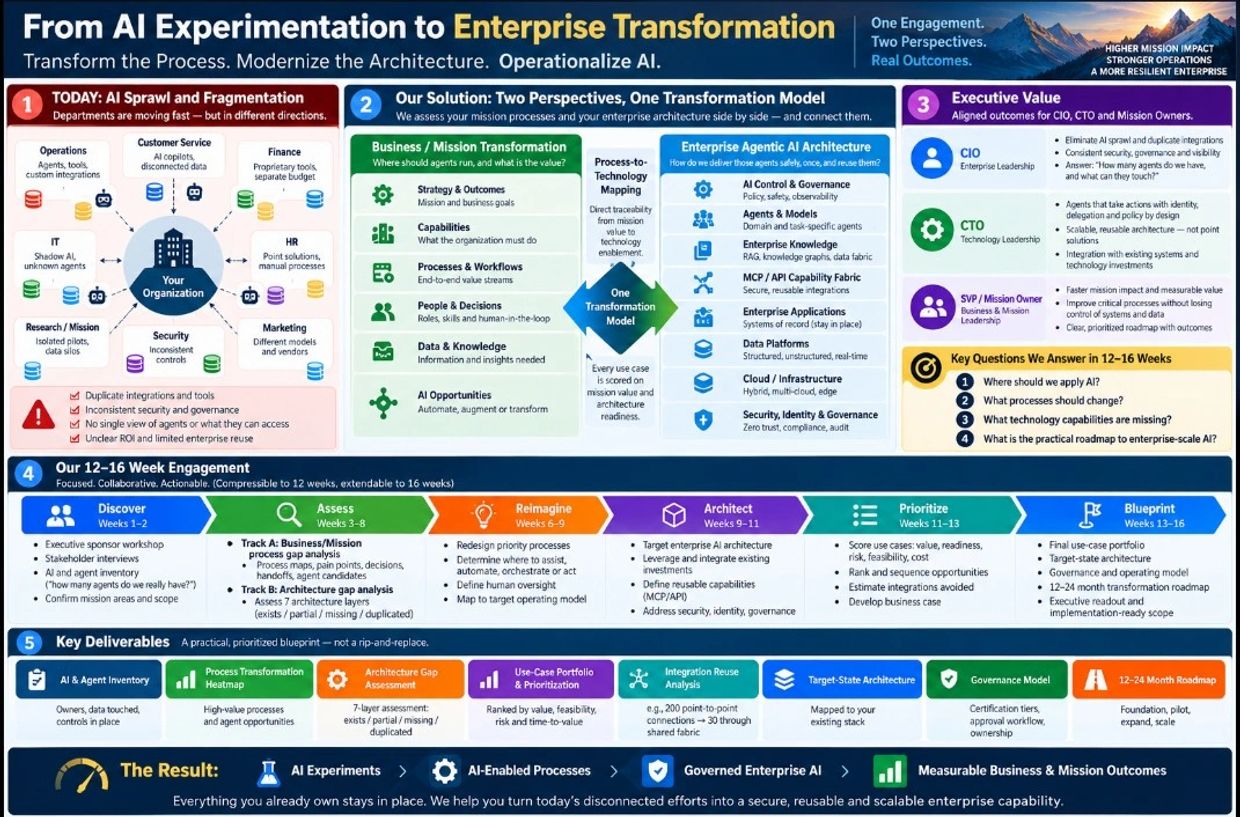
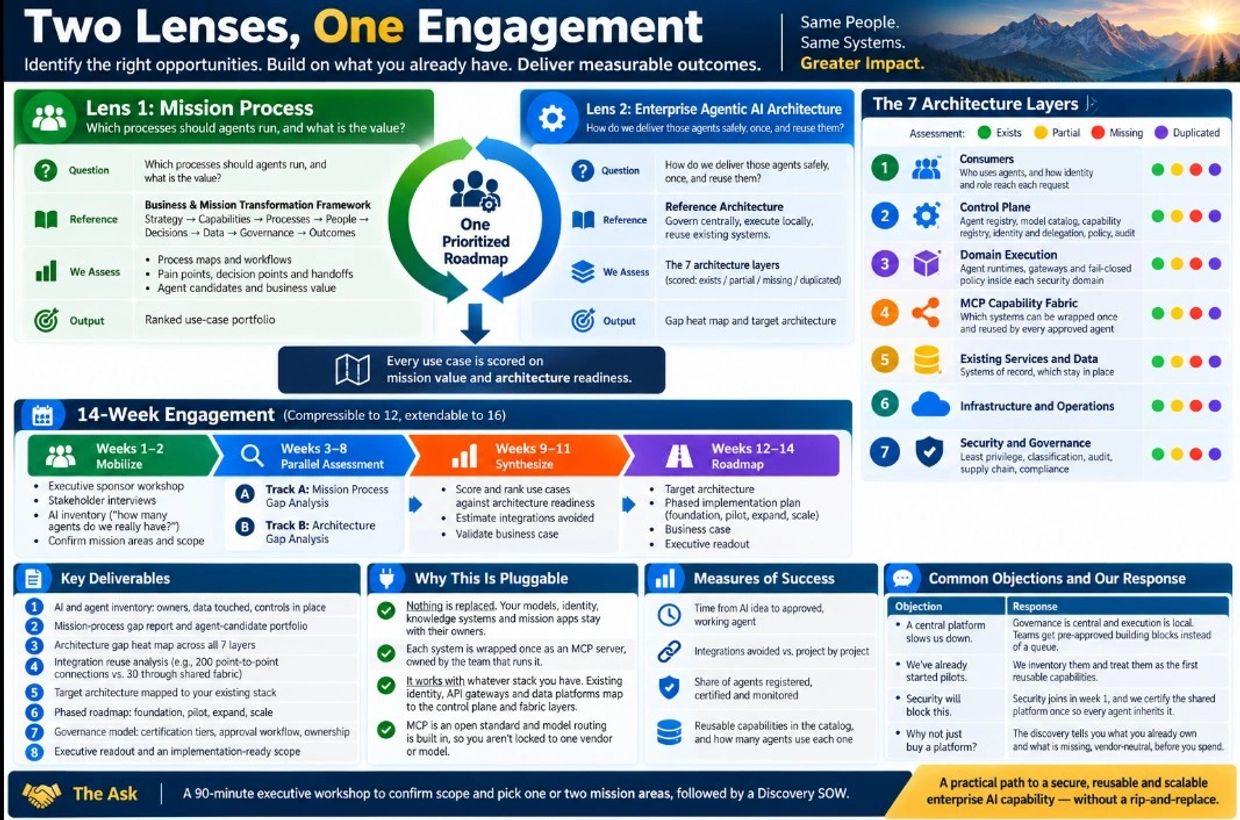
Our **Two Lenses, One Engagement** approach addresses the fundamental challenge facing enterprise AI: ensuring that technology investment is directly connected to measurable business and mission value. We simultaneously examine **where AI and agents can transform critical processes** and whether the enterprise architecture is ready to deploy those capabilities securely, responsibly, and at scale. On the mission side, we identify high-value workflows, decision points, bottlenecks, and agent opportunities; on the technology side, we assess seven architectural layers spanning identity, governance, agent execution, MCP/API integration, enterprise systems, infrastructure, and security. Every opportunity is then evaluated against **both mission value and architecture readiness**, producing one prioritized investment roadmap rather than disconnected AI projects. Our architecture philosophy is straightforward: **govern centrally, execute locally, integrate once, and reuse broadly**—allowing organizations to scale innovation while maintaining security and operational control. Most importantly, this is **not a rip-and-replace strategy**; your existing applications, data, identity platforms, models, and infrastructure remain valuable enterprise assets that we make more accessible and reusable for AI. Within approximately **12–16 weeks**, leadership receives a clear view of what exists today, what is missing, which AI opportunities deserve investment, and the target architecture and governance required to execute them. The outcome is an implementation-ready blueprint that reduces duplicated integration, strengthens governance, accelerates time-to-value, and provides a practical path from isolated AI pilots to a **secure, reusable, enterprise-scale AI capability**. We propose beginning with a **90-minute executive workshop** to select one or two priority mission areas and establish the scope for the Discovery engagement.